
New to mealworms? Read our guide: How to Keep Mealworms Alive for Weeks.
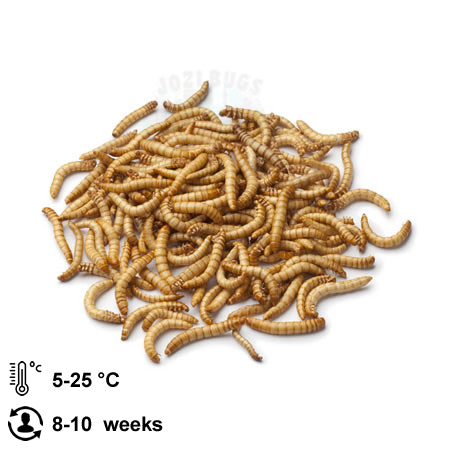
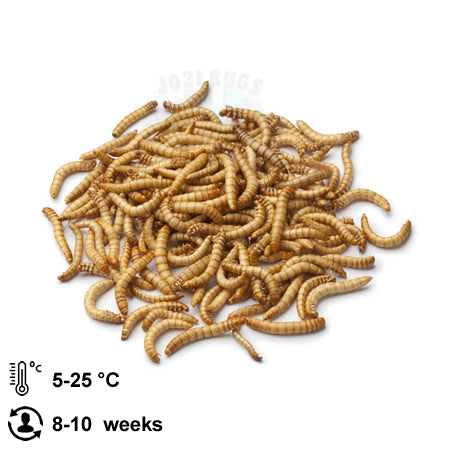
Live mealworms (Tenebrio molitor) are South Africa's most popular staple feeder insect — and our locally bred worms go from farm to your door, never sitting on a shelf. Ideal for leopard geckos, crested geckos, fat-tail geckos, bearded dragons, chameleons, wild garden birds, chickens and fish.
Why keepers choose our mealworms
- Locally bred and packed on dispatch day for maximum tub life
- Consistent sizing with minimal pupae or dead worms
- Available from 25g starter tubs up to 1kg bulk packs for breeders and multi-pet homes
Nutritional value (typical, live basis)
| Nutrient | Approx. value |
|---|---|
| Protein | ~20% |
| Fat | ~13% |
| Moisture | ~62% |
| Fibre | ~2% |
Mealworms are naturally low in calcium relative to phosphorus, so dust them with a calcium supplement before feeding to reptiles.
Keeping your mealworms alive longer
Store them in a ventilated container in the fridge door or a cool room (8–15°C) to slow pupation. Feed them wheat bran (doubles as bedding) and add a slice of carrot or potato as a water source — or use our drown-proof water crystals. Well-kept mealworms last for weeks.
How many worms do I get?
As a rough guide, 100g of medium mealworms is around 800–1,000 worms.
Shipping note (Western & Eastern Cape)
Due to travel distance we can't guarantee live arrival on mealworms to the Cape provinces. We pack every order to survive transit and the overwhelming majority arrive happy and healthy — see our reviews below.
- Choosing a selection results in a full page refresh.
- Press the space key then arrow keys to make a selection.
- Use left/right arrows to navigate the slideshow or swipe left/right if using a mobile device